












How Wall Thickness Affects Molded Pulp Packaging Strength Drying Time and Cost
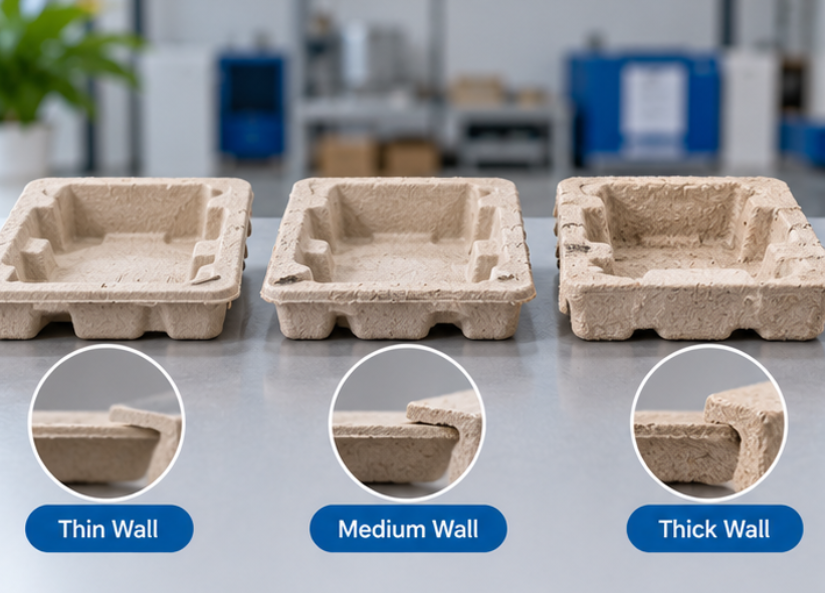
Wall thickness is one of the most important design variables in custom molded pulp packaging. For buyers, it can directly influence how well a tray supports the product, how stable the packaging remains during transportation, how efficiently the part can be produced and how much the final packaging project costs.
A common misunderstanding is that thicker molded pulp automatically means better packaging. In reality, increasing thickness without considering product weight, support points, tray geometry and manufacturing conditions can add material and drying time without creating proportional improvements in protection.
For procurement teams and packaging engineers, the objective is therefore not to specify the thickest possible tray. The objective is to create the correct balance between structural strength, production efficiency, material consumption and total packaging cost.
How Wall Thickness Changes Packaging Strength
Wall thickness affects the rigidity and load bearing ability of a molded pulp tray, but thickness should always be considered together with structural design. A lightweight electronic accessory may require relatively thin sections with accurate locating features, while a heavier appliance or industrial component may need stronger walls and reinforced support areas.
If a molded pulp tray is too thin in critical areas, it may flex excessively under product weight. Corners can deform, support points can collapse and the product may begin to move inside the carton. During repeated handling or long distance transportation, this movement can increase the risk of impact damage.
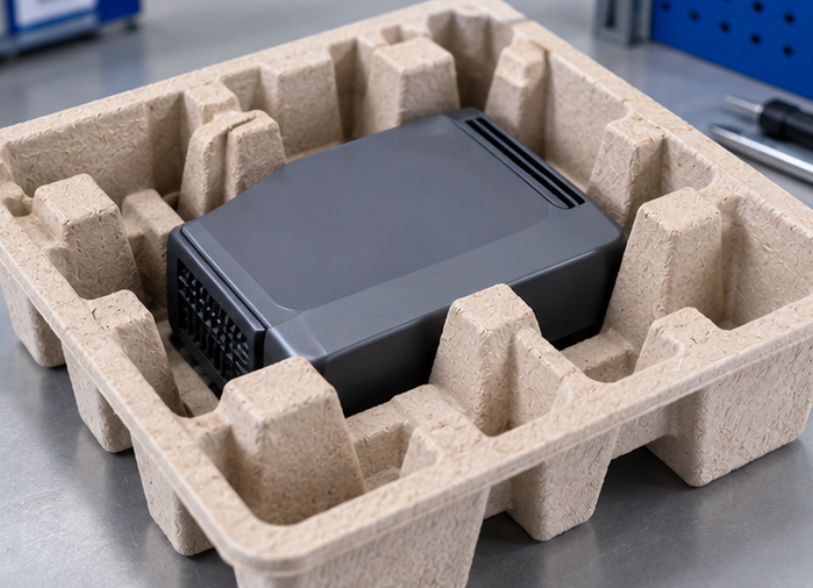
However, simply increasing the thickness of the entire tray is not always the most efficient solution. Good molded pulp packaging design uses geometry to create strength. Ribs, raised support areas, curved transitions, reinforced corners and correctly positioned product contact points can improve rigidity while controlling material consumption.
Buyers should pay particular attention to areas that carry the product weight. Heavy sections of the product should normally be supported by carefully designed load bearing zones rather than relying on a uniformly thicker tray.
Fragile surfaces also require consideration. If the tray becomes unnecessarily rigid or places pressure on sensitive areas, increasing thickness may create a new packaging problem instead of solving the original one. The final structure should therefore be tested with the actual product whenever possible.
Why Thickness Can Affect Drying Time and Production Stability
Wall thickness does not only influence packaging performance. It also affects how the molded pulp part behaves during manufacturing.
A thicker fiber structure contains more pulp material and generally requires more controlled moisture removal during production. If different areas of the tray have significantly different thicknesses, they may not dry at the same rate. This can make process control more demanding and may contribute to dimensional variation or deformation if the structure is not designed correctly.
Complex deep cavities, thick corners and heavily reinforced areas should therefore be reviewed during the tooling and sampling stage. Buyers should not wait until mass production to discover that a packaging design is difficult to dry consistently.
Production efficiency also matters for larger purchase volumes. If a tray requires more material and longer processing time than necessary, the difference may appear small at the sample stage but become significant when hundreds of thousands of pieces are ordered.
Before approving the mold, procurement teams can ask the supplier how the selected thickness affects forming stability, drying conditions, dimensional consistency and expected production output. This discussion is especially valuable for large volume packaging projects.
Finding the Right Balance Between Protection and Cost
Wall thickness has a direct relationship with material usage. When more fiber is required for every tray, the material consumption of the total order increases. Additional processing requirements may also influence manufacturing efficiency and final unit cost.
For this reason, buyers should be cautious when comparing quotations based only on tray weight or thickness. A heavier tray is not automatically a higher quality tray. The important question is whether the additional material is actually contributing to product protection.
An optimized design may use thicker material around major support points while reducing unnecessary material in low stress areas. Structural ribs and carefully designed contours can also help achieve rigidity without making every section equally heavy.
Packaging cost should also be considered beyond the molded pulp unit price. A thicker or poorly designed tray may increase product weight, reduce nesting efficiency and require larger shipping cartons. These changes can affect warehouse space, pallet loading and international freight cost.
When developing custom molded pulp packaging, buyers should provide the supplier with the product weight, dimensions, fragile areas, expected annual quantity, shipping method and any testing requirements. A 3D drawing or physical sample can help engineers determine where additional support is necessary.
Sample testing is also important before mass production. Fit checks, stacking evaluation, compression testing and transportation testing can help confirm whether the selected thickness provides sufficient protection without unnecessary material consumption.
Optimize Wall Thickness Around Real Packaging Requirements
Wall thickness plays an important role in molded pulp packaging strength, production efficiency and cost, but thicker packaging is not automatically better packaging. The most effective structure places material where protection is actually required and uses thoughtful geometry to improve rigidity and product support.
For buyers, the best approach is to evaluate wall thickness together with product weight, support points, drying requirements, nesting efficiency and transportation conditions. Early cooperation with an experienced molded pulp packaging manufacturer can help reduce unnecessary material, improve production consistency and create a more economical packaging solution for mass production.