












Dimensional accuracy is one of the most important quality indicators in molded pulp packaging, especially for buyers sourcing custom trays, inserts, and protective structures for industrial products. A molded pulp package may look acceptable at first glance, but if the dimensions are not controlled properly, it can cause loose fit, assembly problems, unstable stacking, product movement during shipping, and even damage claims from end customers. For electronics, tools, glass parts, small appliances, automotive components, and other precision-sensitive products, dimensional variation can directly affect packaging performance and operational efficiency. That is why buyers should not only ask whether a supplier can produce molded pulp packaging, but also how the supplier ensures dimensional consistency from sampling to mass production.
Mold Design And Engineering Control: Accuracy Starts Before Production Begins
Dimensional accuracy in molded pulp packaging does not begin on the production line. It begins in the design and tooling stage. If the mold structure is not developed correctly, no amount of inspection later can fully solve the problem. That is why the first step in controlling dimensions is to ensure that the packaging design is based on the real product, actual fit requirements, and realistic molding behavior of pulp material.
A professional supplier should review the product drawing, weight, contact points, wall support requirements, and packaging usage conditions before finalizing the mold. The design must take into account pulp shrinkage, drying behavior, draft angle, edge strength, and cavity stability. Molded pulp is not a rigid plastic process. The material changes during forming and drying, so the tool must be engineered with compensation in mind. Buyers should therefore ask whether the supplier has experience designing molds specifically for custom industrial packaging rather than only making general trays.
Another important point is whether the supplier can verify the design before full tooling investment. Sample development, prototype testing, and fit validation are critical for avoiding dimensional errors later. If a supplier can only make a mold and wait for the result, the risk is much higher. Strong suppliers usually refine structural details early, confirm how the product sits inside the tray, and reduce tolerance problems before mass production starts. In many cases, good dimensional control is not the result of inspection alone. It is the result of correct engineering decisions made from the beginning.

Process Stability And Material Control: Consistent Dimensions Depend On Stable Manufacturing Conditions
Even with a good mold, dimensional accuracy cannot be maintained without stable process control. Molded pulp packaging is sensitive to many production variables, including pulp composition, water content, forming pressure, drying temperature, cycle time, trimming method, and ambient humidity. Small changes in these conditions can lead to warping, uneven shrinkage, inconsistent thickness, and poor tray fit. That is why buyers should evaluate how the supplier manages manufacturing stability, not just final inspection.
Material consistency is a major factor. Suppliers should control the pulp ratio, fiber quality, slurry concentration, and moisture behavior so that each batch forms in a similar way. If the raw material changes too much, the molded part can shift in size or shape even when the same mold is used. Drying control is equally important. If the tray dries too quickly, too slowly, or unevenly, it may distort after forming. For products with tight fitting requirements, such distortion can create serious packaging problems.
Production rhythm also matters. A well-managed supplier should maintain stable forming conditions from the first batch to the last batch. Buyers should ask whether the supplier tracks process parameters, checks mold condition regularly, and controls post-forming trimming consistently. In high-volume industrial orders, the difference between a good supplier and a weak one is often not sample appearance but batch-to-batch repeatability. Dimensional accuracy can only be maintained when material control, machine settings, drying process, and handling methods all work together in a stable system.
Inspection Standards And Tolerance Management: Accuracy Must Be Measured, Confirmed, And Maintained
Dimensional accuracy cannot rely on assumption. It must be defined clearly, checked systematically, and maintained throughout production. Buyers should therefore confirm not only that the supplier inspects products, but also what exactly is being measured, what tolerances are accepted, and how nonconforming parts are handled. Without clear standards, “acceptable size” can become a vague and risky concept.
The first step is to define critical dimensions. Not every area of a molded pulp tray carries the same importance. Some surfaces only affect appearance, while others directly control product fit, top cover closure, stacking height, or loading efficiency. Buyers should work with the supplier to identify the key dimensions that must be controlled more tightly. These may include cavity length and width, support height, edge location, nesting depth, and tray-to-carton fit. Once these points are defined, both sides can set practical tolerances based on packaging function rather than guesswork.
Inspection discipline is equally important. A reliable supplier should use first article approval, in-process measurement, and finished goods checks to confirm accuracy continuously. If dimensional drift appears, the supplier should be able to stop the issue early and correct it before the full batch is affected. Buyers should also ask whether the supplier keeps records by mold number, shift, or production date for traceability. For industrial procurement, tolerance management is not just about technical precision. It is about reducing risk, protecting line efficiency, and making sure repeat orders behave like the approved sample.
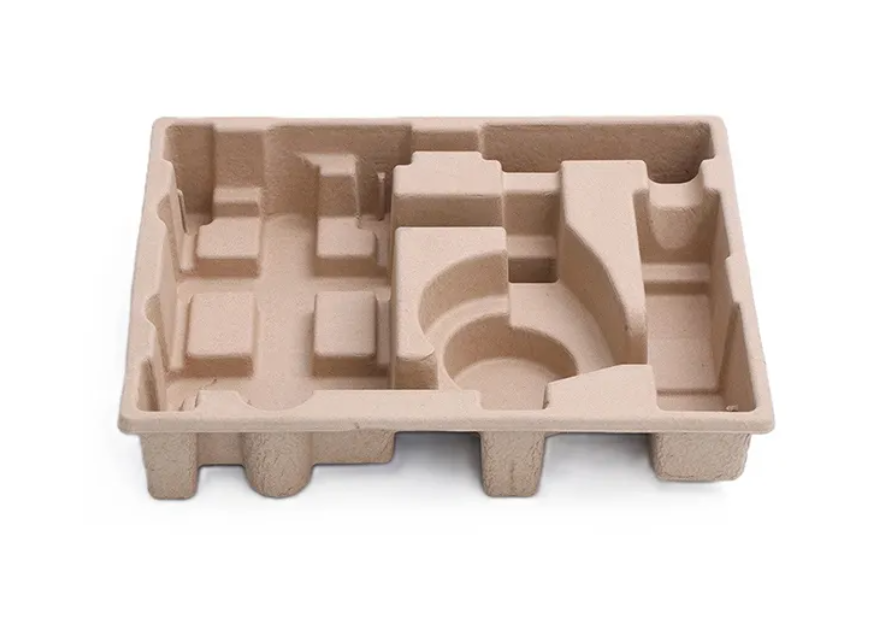
To ensure dimensional accuracy in molded pulp packaging, buyers should focus on three core factors: mold and engineering quality, stable manufacturing control, and clear tolerance inspection. A supplier that performs well in all three areas is far more likely to deliver packaging that fits correctly, protects products effectively, and remains consistent in repeat orders. In real procurement, dimensional accuracy is not a minor detail. It is one of the foundations of packaging reliability, production efficiency, and customer satisfaction.